
Choosing Focaccia Toppings Without Weighing Down the Dough
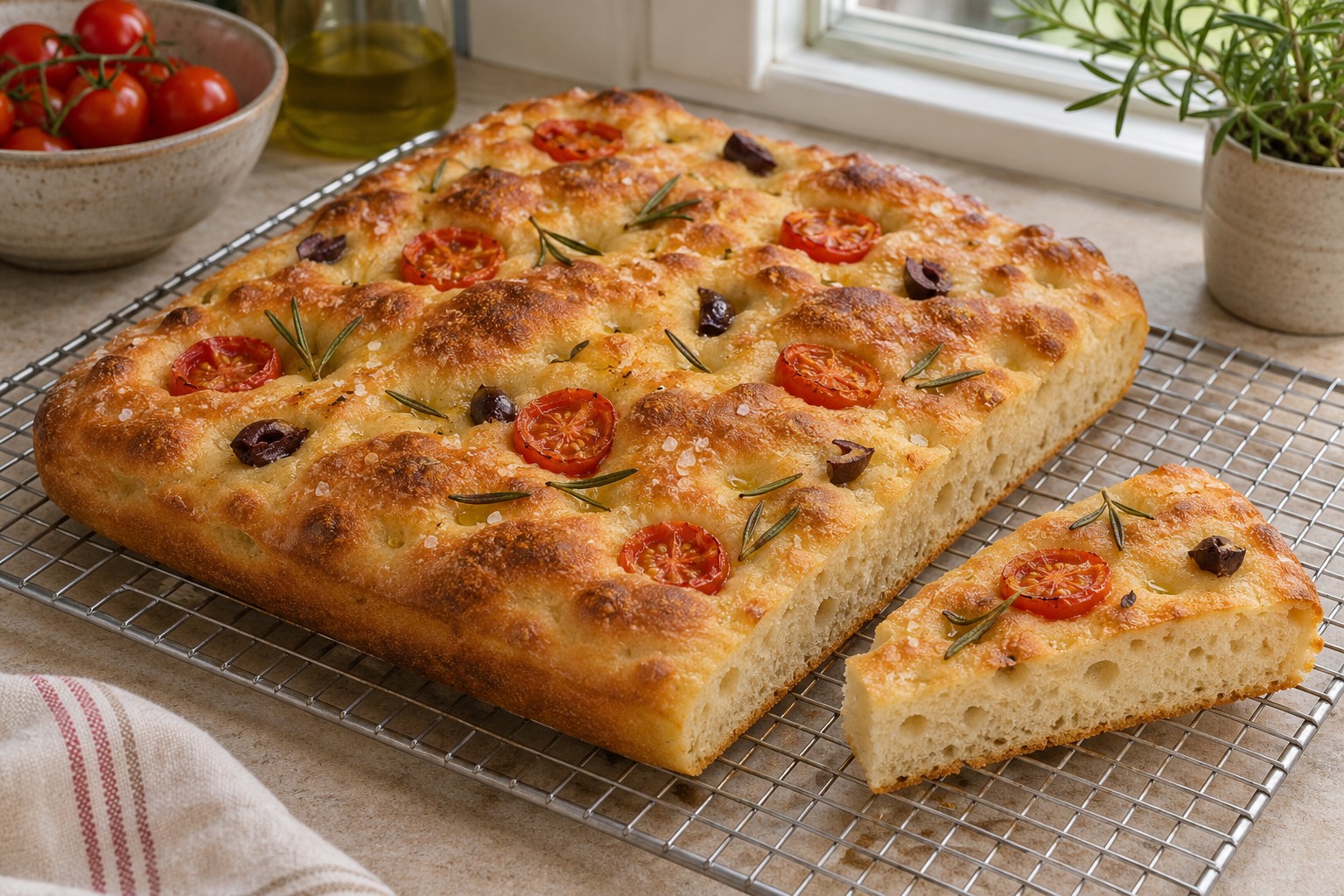
A handful of tomatoes looks modest in a bowl. Add olives, onions, cheese, and another drizzle of oil, and suddenly the dough is barely visible. Each ingredient may suit focaccia, but together they can turn a light topping into a thick, wet covering.
Choose focaccia toppings by considering moisture, piece size, and coverage together. Drain ingredients that arrive in liquid, prepare vegetables to suit their thickness, and distribute small amounts across the surface. Leave visible dough between the toppings so you can also observe how the bread is baking.
Start with the bread you want to eat
For an airy focaccia with a browned, dimpled surface, treat toppings as scattered accents. If you want a generous layer of sauce, vegetables, and melted cheese, use a recipe designed for focaccia pizza rather than assuming a plain bread recipe will bake identically under that covering.
This distinction matters because weight is only part of the problem. In its focaccia pizza guidance, King Arthur Baking explains that excess topping liquid can contribute to underbaked areas and that overloading can lengthen baking. Its advice to precook especially wet vegetables belongs to that more heavily topped context; it does not mean every vegetable on every focaccia must be cooked first.
Begin with one main topping and one or two smaller flavor accents. Tomato with rosemary, or cooked mushrooms with a little onion, gives you a clear starting point. These are combination ideas, not tested topping formulas or guaranteed quantities for every pan.
Keep your base recipe’s pan size, dough quantity, proofing cues, and oven instructions together. The broader guide to wet dough, folds, and an airy focaccia crumb explains that workflow; toppings come after those foundations, rather than compensating for them.
Prepare moisture before toppings meet the dough
Look at the ingredient as it will actually go onto the bread. An olive lifted from brine, a freshly washed herb, and a spoonful of cooked mushrooms can all carry liquid that you do not need to pour onto the dough.
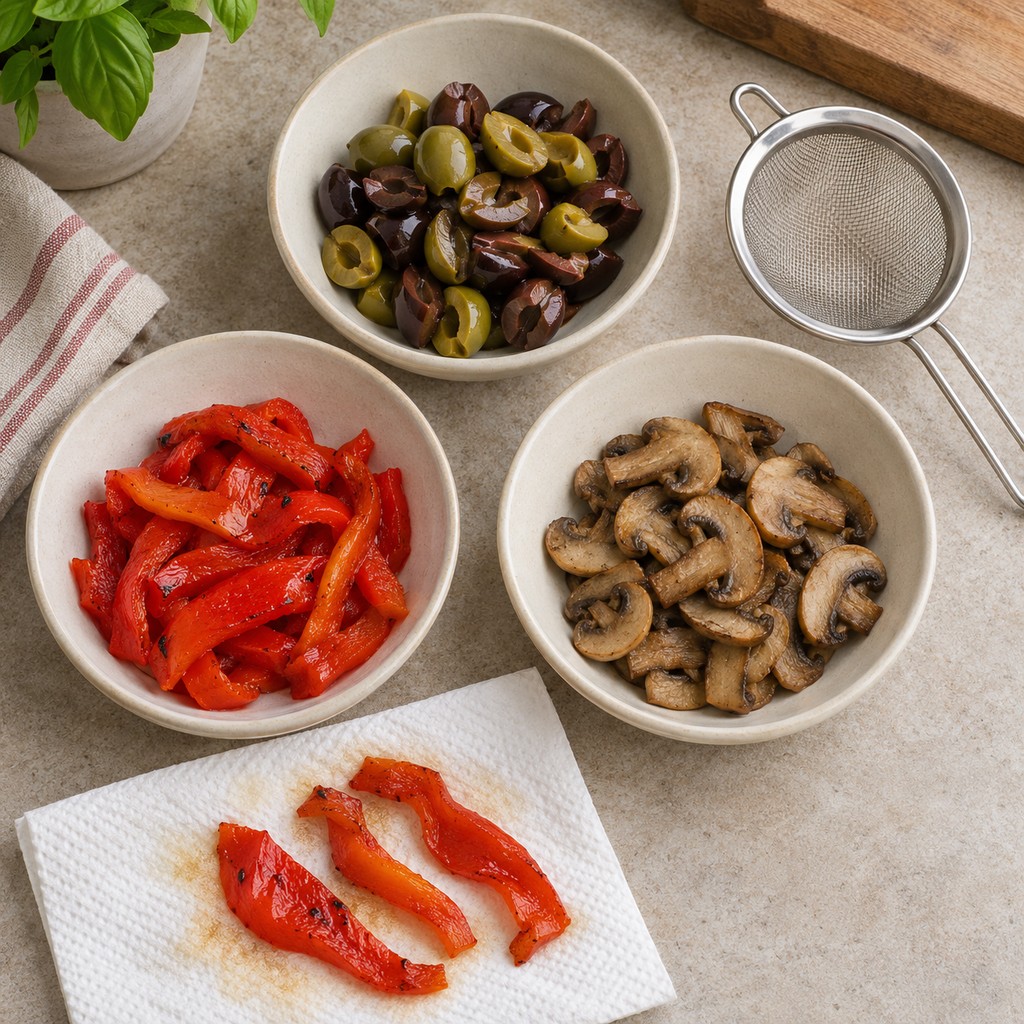
Drain preserved ingredients in a sieve, then blot their surfaces where practical. Dry washed vegetables and herbs before cutting or arranging them. For cooked toppings, leave loose cooking liquid behind rather than tipping the whole pan onto the bread.
Use the following as preparation choices, adjusting them to your recipe and the ingredients in front of you:
| Topping | Useful preparation | What to avoid |
|---|---|---|
| Olives or capers | Drain well; pit olives and cut large ones into smaller pieces | Spoonfuls of brine and concentrated heaps |
| Tomatoes | Use small pieces or halves; leave accumulated cutting-board juice behind | Thick overlapping slices covering most of the dough |
| Mushrooms or spinach | For a more substantial topping, cook first to reduce liquid; drain if needed | A thick layer of wet raw vegetables |
| Onion | Slice thinly for a light raw topping, or cook first for a softer result | Thick piles that need a different cooking time from the bread |
| Jarred roasted peppers | Drain, blot, and cut into manageable strips | Adding the jar liquid with the peppers |
| Fresh mozzarella | Drain and blot, then use small, separated pieces | A continuous blanket of wet cheese |
Precooking is a tool, not a requirement for all vegetables. King Arthur Baking’s garden focaccia guide uses prepared raw vegetables in a hot bake. Thin pieces and restrained coverage are a different proposition from a deep mound of mushrooms or spinach.
If you precook vegetables, prepare them ahead of the final topping stage and let them cool before placing them on the dough. You should be ready to scatter them gently, without interrupting the finishing sequence to cook another ingredient.
Match piece size and coverage to the pan
A topping should be easy to distribute without having to press a large, awkward piece into place. Cut broad slices into smaller portions and separate onion strands or vegetable strips before approaching the dough.
Think across the whole pan rather than filling one area completely and moving outward. Place the main topping in a loose pattern, then step back. Add the smaller accents only where they contribute flavor, leaving patches of dough visible between them.
There is no dependable universal topping weight for every focaccia. The same quantity lands differently on a small, deep loaf and a broad, shallow one. Ingredients also behave differently: drained olives and juicy tomatoes are not equivalent simply because they weigh the same.
For example, if you choose tomato and olive, distribute the tomatoes first, then add olive pieces into some of the spaces. Do not fill every remaining gap just because there are ingredients left in the bowls. Leftover topping is easier to use elsewhere than an overloaded pan is to undo.
Also consider how the bread will be served. A focaccia intended for sandwiches may need only herbs and a modest scattering of toppings. A loaf served alongside soup can carry a more noticeable vegetable accent without needing to become a complete meal on its surface.
Add toppings without repeatedly flattening the dough
Have the toppings prepared before the dough reaches your recipe’s finishing stage. Follow that recipe’s order for surface oil, dimpling, and topping; different methods arrange these steps differently.
Place pieces with a light touch. Where the method calls for it, gently nestle a topping into a surface indentation rather than pushing it through the dough. Avoid repeatedly dimpling the same patch to make a tomato or onion strip sit in a perfectly straight line.
If the dough still resists spreading across the pan, resolve that handling issue before decorating. The guide to focaccia dough that springs back in the pan explains resting and stretching checks. Toppings should not become weights used to pin reluctant dough into the corners.
Keep the recipe’s oil allocations separate, too. Oil in the dough, oil in the pan, and finishing oil have different places in the method. If your vegetables are already coated in cooking oil, notice that before adding another unmeasured pour. Aim to follow the recipe’s finish rather than adding oil automatically whenever the surface looks busy.
Save delicate finishes for after baking
Not every flavor needs to spend the full bake in the oven. Basil and parsley are useful finishing choices; King Arthur Baking’s garden focaccia guide recommends adding these delicate herbs after baking to preserve their fresh color.
This gives you another way to keep the unbaked surface simple. Bake with your chosen sturdy topping, then add a small fresh accent before serving. For instance, tomato focaccia can receive torn basil afterward instead of carrying several layers of vegetables into the oven.
Treat generous sauces, spreads, or soft toppings as serving additions when that suits the meal. You can offer them alongside slices, allowing the bread itself to bake according to its intended method.
Read the bread as well as the toppings
Start with your recipe’s baking temperature and timing range, then observe the exposed dough, edges, and underside as directed. A dark onion tip or browned cheese patch does not establish that the bread beneath it has finished baking.
Watch for uneven progress. Are the bare areas coloring while a heavily topped patch remains pale and wet-looking? Are small exposed pieces darkening well ahead of the loaf? These observations help you distinguish a topping problem from a reason to remove the entire bread early.
If the finished focaccia has a damp layer directly beneath a cluster of vegetables, record where it occurred and how those ingredients were prepared. That pattern is worth investigating, but it does not prove toppings were the only cause. Dough fermentation, loaf depth, and baking also affect the result.
For the next batch, change one topping decision at a time: drain more thoroughly, use smaller pieces, reduce coverage, or move a delicate ingredient to the finish. Keep the base dough method steady so the comparison means something.
The most useful stopping point comes before every empty space disappears. When the toppings are spread evenly, their surfaces are free of unnecessary liquid, and the dough still has room to show through, leave the remaining ingredients in their bowls and let the bread take its turn in the oven.
Bake & panduan terkait
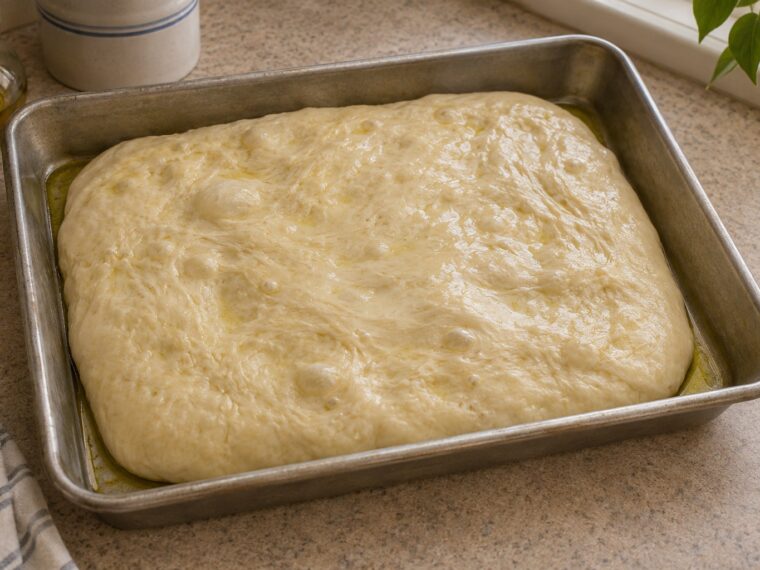
Focaccia Dough Springs Back in the Pan: Resting and Stretching Checks
When focaccia pulls back from the pan’s corners, more force rarely helps. Use a covered rest, gentle handling,…
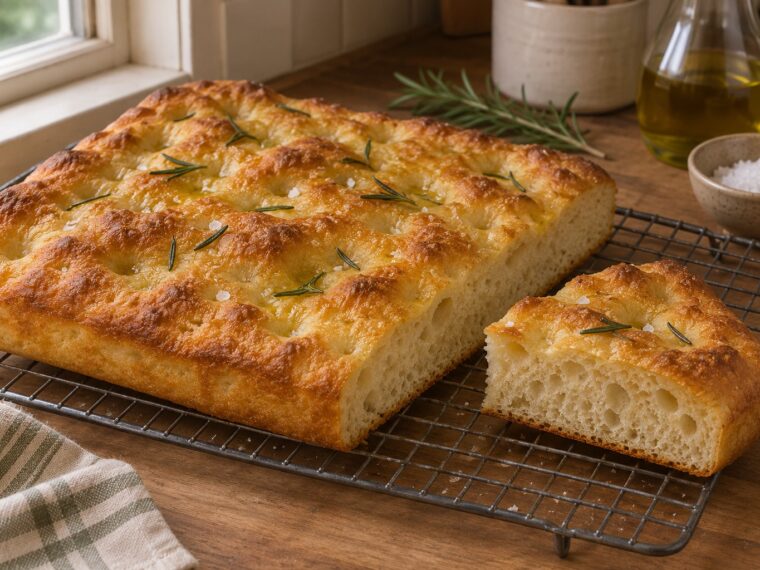
Same-Day Focaccia: A Recipe with Fold and Proofing Cues
A bowl-and-pan focaccia recipe with a simple olive oil topping. Follow the dough’s stretch, expansion, and wobble alongside…
Focaccia at Home: Wet Dough, Folds, and an Airy Crumb
Sticky focaccia dough needs a different approach from soft bread rolls. Learn what to notice from the first…