
How to Use an Oven Thermometer Before Adjusting a Recipe
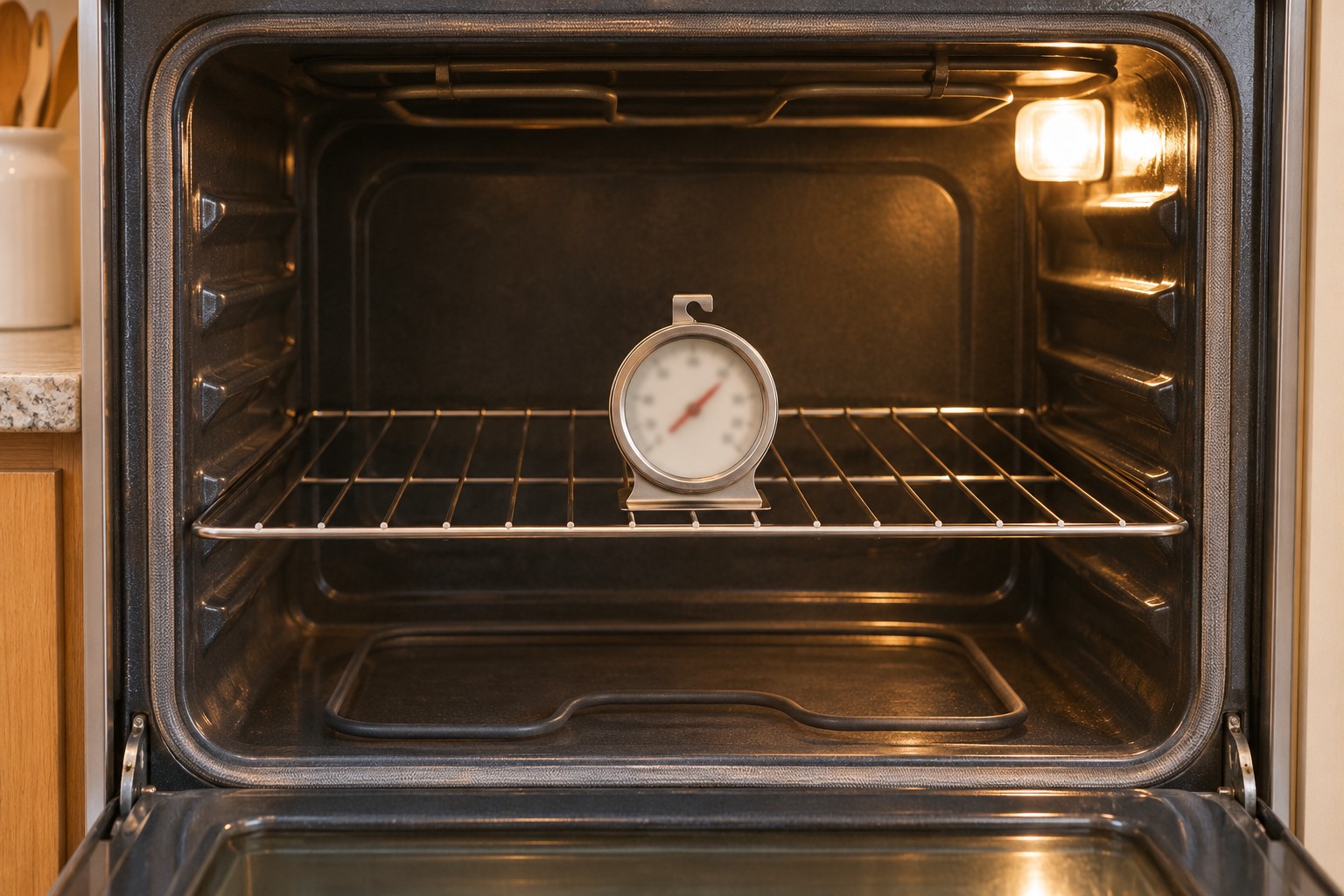
A cake takes longer than expected, so you look through the oven window. The thermometer reads below the dial setting. It is tempting to turn the heat up immediately—but that number may be one moment in the oven’s normal heating cycle.
To use an oven thermometer meaningfully, keep its position and the oven setting consistent, observe several readings after preheating, and look for a repeated pattern. The aim is to gather enough information to make one sensible change, rather than adjusting the recipe around a moving needle.
Start with the oven instructions and the right thermometer
Choose a thermometer explicitly intended to remain inside an oven at your intended baking temperature. Follow its instructions for placement, temperature range, and handling. A thermometer used for checking the center of food is not automatically suitable for measuring oven conditions throughout a bake.
Read your oven manual before treating a separate thermometer as a calibration tool. Manufacturers differ in how they recommend assessing temperature problems, and a household thermometer does not provide a service diagnosis. GE Appliances notes limitations in oven thermometer accuracy and consistency, particularly when reading one requires opening the door.
Check the units before switching anything on. Keep your notes in Celsius if that is how your oven is marked; convert a Fahrenheit recipe separately. Also identify the intended cooking mode. A conventional setting and a fan-assisted setting are different conditions, even when the temperature number matches.
If you are still sorting out those choices, the guide to understanding your home oven explains mode, rack position, airflow, and baking cues together. Here, keep those variables fixed while you investigate the temperature pattern.
Position the thermometer before heating
With the oven cool, arrange a rack and position the thermometer according to the appliance and thermometer instructions. For a general check, the center of a middle rack is a common starting point; Stirling Marathon’s temperature-testing guidance uses this arrangement.
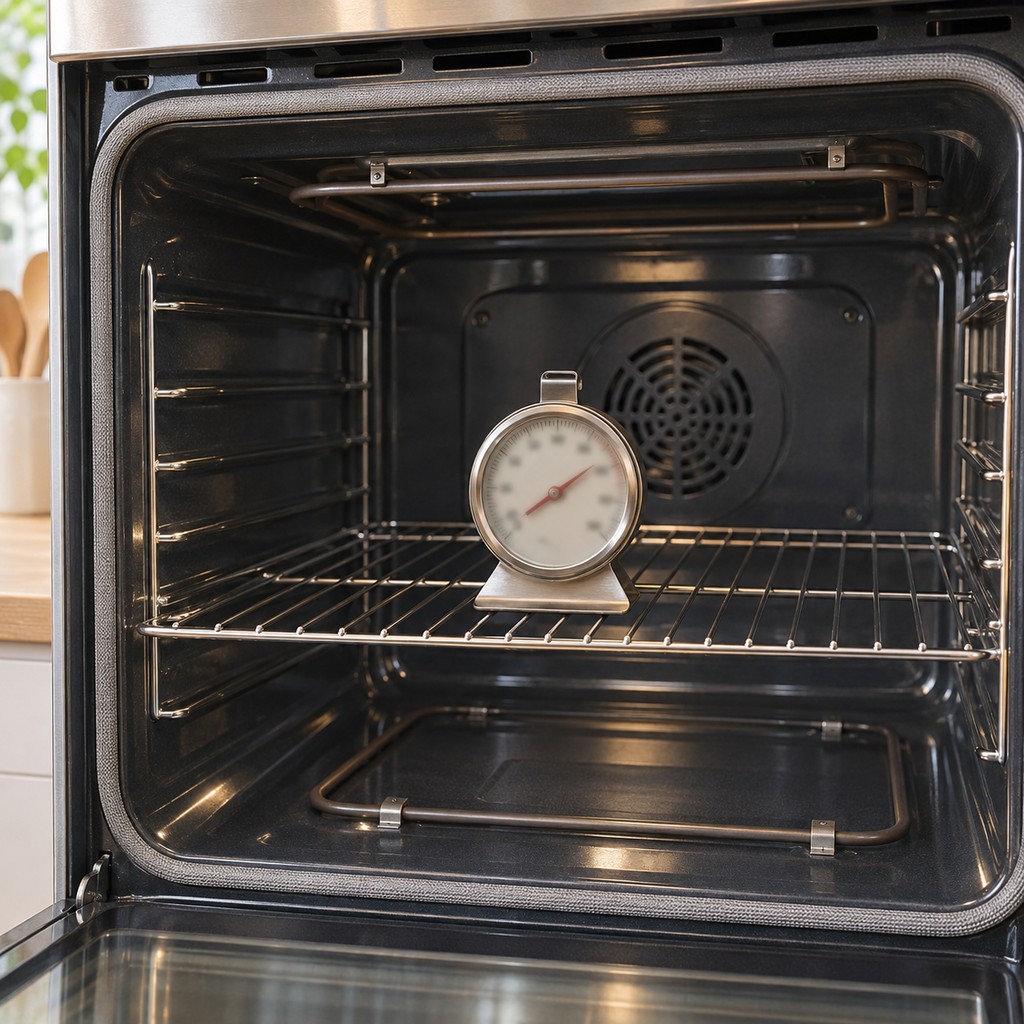
Stand or hang the thermometer securely as its design permits. Keep its measuring body clear of the oven walls and heating elements, and face the dial toward the window where possible. Avoid a position where a tray will knock it over when loaded.
For an initial observation, leave the oven otherwise empty unless the manufacturer specifies a different testing arrangement. Record that condition. An empty-oven observation should remain identified as such, rather than being described as a measurement taken beside a loaded cake pan.
One position also cannot describe every part of the cavity. Resist moving the thermometer between shelves during the same run. That changes the measurement location while the oven is also changing temperature, leaving two explanations for a different reading.
Watch several cycles after preheating
Set the intended baking mode and temperature, close the door, and follow the oven’s preheating instructions. Keep the setting unchanged while observing what happens next.
Ovens do not necessarily hold the air at one unchanging number. GE Appliances explains that heating cycles produce temperatures above and below the selected setting, with the amount of variation depending on the appliance and measurement conditions. A reading below the setting can therefore be part of a cycle rather than evidence of a persistent shortfall.
Continue observing beyond the first preheat signal according to your manufacturer’s testing guidance. There is no single waiting period suitable for every oven. As one manufacturer-specific example, Stirling Marathon recommends allowing at least 30 minutes of cycling after preheating, then recording several readings over 20 minutes. Use your own appliance’s procedure when one is supplied.
Keep a simple record:
- Selected temperature, unit, and oven mode.
- Thermometer position and whether the oven is empty.
- Time of each observation and the displayed reading.
- Any door opening or setting change.
Read through the window with the oven light if possible. Opening the door changes the conditions you are trying to observe. If you must open it to see the dial, note that limitation rather than treating the next low reading as proof that the oven runs cold.
Look for repeated rises and falls, rather than waiting for one preferred number. If the dial is difficult to read, record an approximate reading honestly; do not give a coarse scale the appearance of laboratory precision.
Separate a fluctuating reading from a repeated discrepancy
Consider the whole sequence before deciding what it means. Several readings that move above and below the setting tell a different story from readings that repeatedly remain on one side of it after the prescribed settling period.
For a simple hypothetical example, equally spaced readings of 165°C, 175°C, and 185°C have an arithmetic mean of 175°C. Selecting only the lowest reading would suggest a cold oven; selecting only the highest would suggest a hot one. Neither describes that small set fairly.
An average is still only as useful as the observations behind it. Take readings at consistent intervals across repeated cycles, following the manufacturer’s method. Do not average a few convenient numbers, or assume that the midpoint between one high and one low accurately represents the entire period. Thermometer uncertainty also remains after the arithmetic.
| Observation | Useful next step |
|---|---|
| Readings rise and fall around the selected temperature | Avoid changing the setting in response to each swing; assess the wider pattern and baking results. |
| Readings repeatedly appear low or high across comparable runs | Check the measurement method and follow the appliance’s temperature-assessment guidance. |
| A low reading follows a door opening | Record the opening and allow recovery under the manufacturer’s procedure before interpreting later observations. |
| Readings are inconsistent or difficult to trust | Check the thermometer’s condition and instructions before drawing conclusions about the oven. |
Repeat a concerning observation on another occasion with the same mode, position, and procedure before assigning the oven a permanent correction. If a decision depends on a questionable thermometer, follow its manufacturer’s accuracy-check or replacement guidance. Do not improvise an immersion test for an instrument that is not designed for it.
Choose the next change from the evidence
A repeated temperature discrepancy is a reason to investigate further, not a reason to change the oven setting, baking time, pan, and ingredients together. Keep the recipe intact while checking what the appliance manufacturer recommends.
If the manual provides a user temperature-offset procedure, follow that procedure and its limits. Changing an oven’s calibration setting is a separate action from temporarily choosing a different baking temperature. Avoid applying both corrections without accounting for them, or the next batch will have another variable to untangle.
Do not assume that an apparent discrepancy at one temperature establishes the same correction at every setting or in every mode. Keep notes specific: the temperature selected, the mode used, and the conditions observed. Persistent heating problems or erratic behavior belong with the manufacturer or a qualified service technician, rather than repeated recipe compensation.
If the temperature pattern does not explain the result, return to the bake itself. A loaf that browns outside while remaining wet in the middle also calls for checking pan dimensions, batter depth, and rack position. A tray that colors more strongly on one side raises a different question, covered in Why Bakes Brown on One Side: Rack Placement and Oven Hot Spots. For bakeware differences, see Light Metal, Dark Metal, or Glass: Choosing a Baking Pan.
Keep using the recipe’s doneness cues alongside its timing. An oven thermometer describes conditions at its own location; it cannot tell you whether a cake’s center has set or a cookie has reached its intended texture.
For the next batch, carry forward one clear observation and one justified action. That might mean allowing the prescribed preheating period, following the manual’s temperature assessment, or keeping the oven setting unchanged while correcting the pan choice. A useful thermometer reading helps narrow the question before you rewrite the recipe.
Bake & panduan terkait
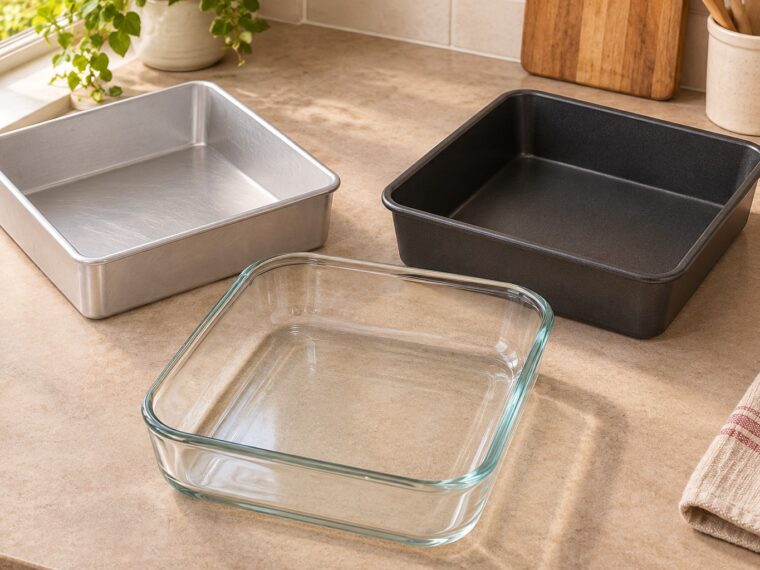
Light Metal, Dark Metal, or Glass: Choosing a Baking Pan
The pan beneath your batter affects more than its shape. Learn when light metal, dark metal, or glass…
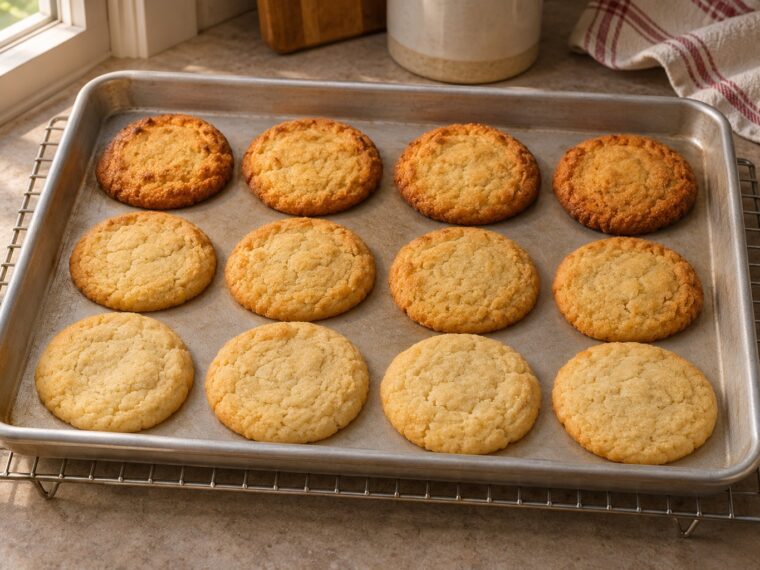
Why Bakes Brown on One Side: Rack Placement and Oven Hot Spots
A darker back row of cookies does not automatically mean the oven is too hot. Follow the browning…
Understanding Your Home Oven: Heat, Rack Position, and Baking Cues
A browned top and an unfinished center can happen in the same bake. Understand how oven mode, rack…