
When to Cut Brownies for Neater Slices
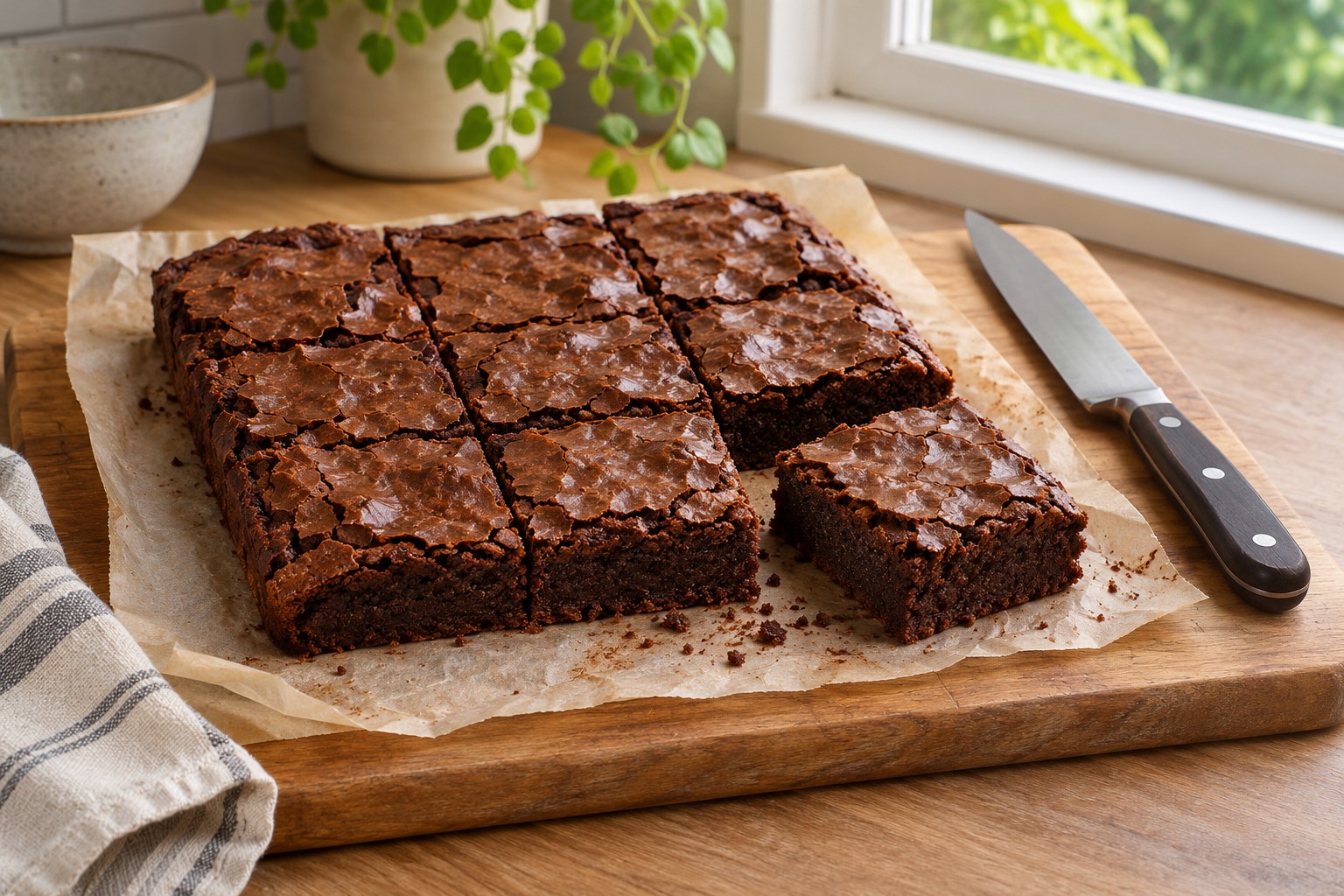
A warm brownie can be delicious, but it is often too soft to give you a tidy square. The knife pulls at the center, the top cracks, and the first piece may leave half its edge behind in the pan.
For neater slices, let properly baked brownies cool completely before cutting. The time varies with the recipe, pan, brownie depth, and kitchen temperature, so use the feel of the slab as your guide rather than a fixed number of minutes. If you prefer a warm piece and do not mind softer edges, cut earlier and serve it with a spoon or small spatula.
Let the pan cool before deciding
Place the pan on a cooling rack and follow the recipe’s cooling directions. For the cleanest cuts, wait until the pan and brownie center no longer feel warm. The surface should feel set, and a gentle touch should not leave the middle shifting like a hot, fragile slab.
The edges can cool before the center, particularly in a deep pan. If the outside feels cool but the middle still feels warm, give it more time. A thin, cakier brownie may become easy to handle sooner than a thick, fudgy one; neither needs to match a universal cooling schedule.
Cooling changes how a baked brownie handles, but it does not fix an unbaked center. Before the pan leaves the oven, follow the recipe’s own doneness cues. If a recipe calls for moist crumbs on a skewer, distinguish them from liquid batter; melted chocolate pieces can make the result harder to read. Brownie Texture Explained: Fudgy, Chewy, and Cakey looks more closely at those differences.
Lift the slab without breaking it
A parchment sling makes it easier to move the whole cooled slab to a board. If the recipe uses one, leave enough parchment extending over opposite sides of the pan before baking. Once the brownies are cool, loosen any exposed edges gently with a thin spatula, taking care not to scratch the pan. Hold both ends of the parchment and lift slowly, supporting the underside if the slab is large or flexible.
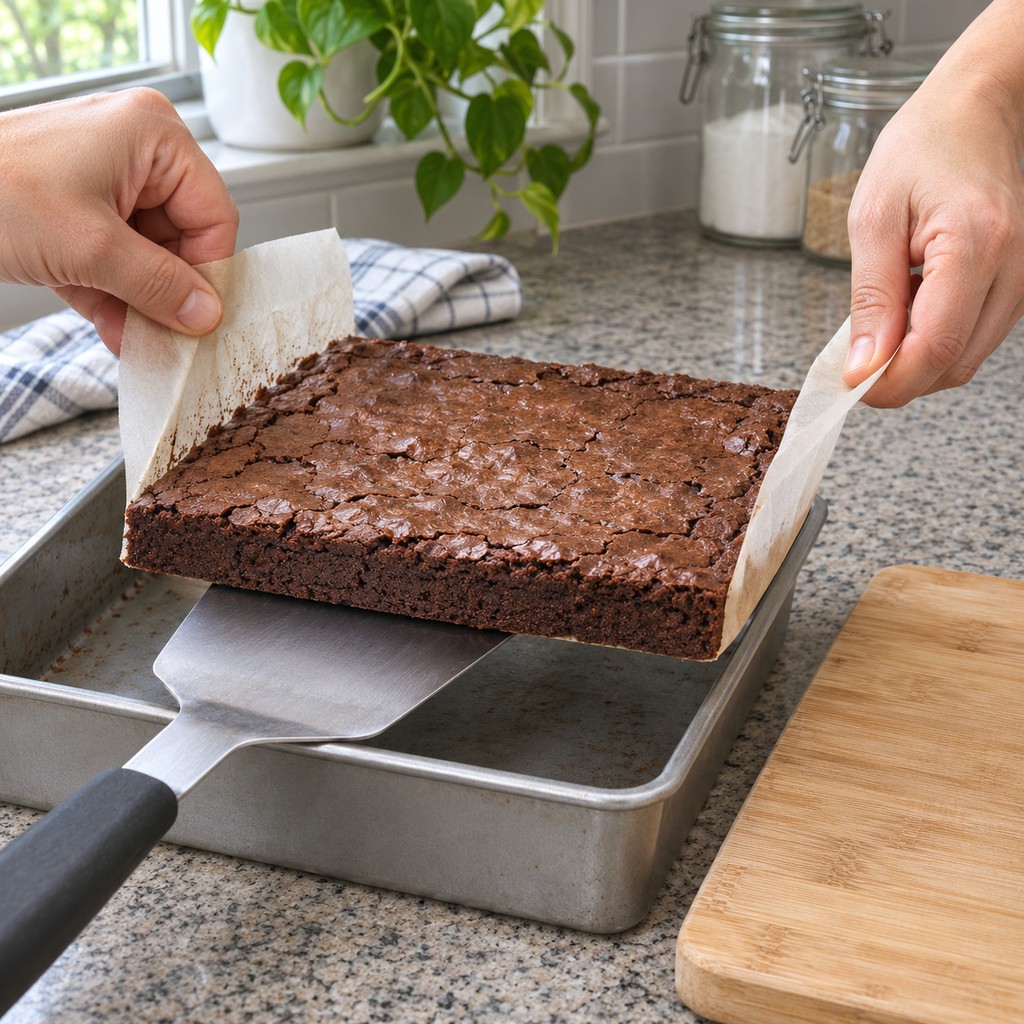
Set the slab on a stable cutting board, then peel the parchment away from the sides. If it bends or threatens to split, lower it back into the pan and let it cool longer. A wide spatula underneath can help support a delicate slab during the move.
Without an overhang, cut in the pan if its surface and manufacturer’s instructions allow it. Use a utensil that will not damage the pan, and lift the first piece carefully with a small spatula. The first square may be untidy; the space it leaves makes the others easier to remove. Alternatively, loosen the cooled slab and support it with a board as you turn it out, but avoid this if a soft topping or fragile crust would be damaged.
Choose a knife and make deliberate cuts
A long, sharp, straight-edged knife gives you room to cut across the slab without repeatedly dragging through the same line. Use a blade long enough for the width when possible; if it is shorter, work along the line in controlled sections rather than pulling the brownie apart.
- Place the cooled slab on a stable board. Mark the portions lightly with the tip of the knife before cutting if even sizes matter.
- Press the blade down through the brownie in a steady motion. For a long cut, lower the blade along the line without sawing back and forth excessively.
- Lift the knife clear. Wipe both sides with a clean cloth or paper towel before the next cut, especially if soft chocolate has collected on it.
- Repeat in one direction, then turn the board and cut across the strips. Lift each piece with a small spatula if the center is delicate.
A warm, dry blade may help it move through a sticky brownie: dip the knife in hot water, then dry it carefully before cutting. Keep water away from the brownie and handle the hot blade with care. If warming the knife makes the chocolate smear more, return to a clean, room-temperature blade.
What to do when the cuts still look messy
The center sticks to the blade. Wipe the knife more often and make the next cut without dragging it sideways. If the slab is still warm, wait. A completely cool but very soft brownie may benefit from a short chill until it feels firmer; check it periodically rather than waiting for it to become hard. Let the pieces sit briefly before serving if you prefer a softer bite.
The top cracks as you press. Use a sharp blade and a gentle, steady downward motion. A delicate crust can still crack even when the interior is cool, so aim for portions that hold together rather than a perfectly unbroken surface.
The brownie crumbles. Avoid repeated sawing and support each piece as you lift it. If the brownie is dry throughout, a sharper knife cannot restore moisture. For the next batch, review the recipe’s pan size and baking cues rather than trying to solve a baking problem through cutting alone.
The slab bends when lifted. It may still be warm or simply very tender. Cool it longer, support it from below, or portion it in the pan with a pan-safe utensil. There is no need to force a fragile slab onto a board.
Plan around toppings and serving
Cut plain brownies before adding a soft topping when the recipe allows it. If the topping is already on the slab, follow its instructions: a soft layer may need to set before slicing, and a clean blade between cuts helps keep the layers distinct.
For brownies with a perishable topping or filling, such as one that requires refrigeration, do not leave them at room temperature indefinitely while waiting for ideal slices. Follow the recipe’s handling directions and refrigerate as appropriate. The U.S. Food and Drug Administration’s storage guidance advises refrigerating foods that require cold storage within two hours, or within one hour when the air temperature is above 32°C.
If you are planning a batch around clean portions, the fudgy cocoa brownie recipe uses a parchment overhang and calls for the brownies to cool completely in the pan. Leave room in your schedule for that cooling step: the neatest cut starts before the knife touches the crust.
Bake & panduan terkait
Why Brownies Turn Dry at the Edges Before the Center Sets
Dry edges and a soft middle can point to a mismatch between the batter, pan, and oven. Learn…
Fudgy Cocoa Brownies: A Recipe with Center and Edge Cues
These small-batch cocoa brownies use a loaf pan and a straightforward mixing method. Learn what set edges, a…
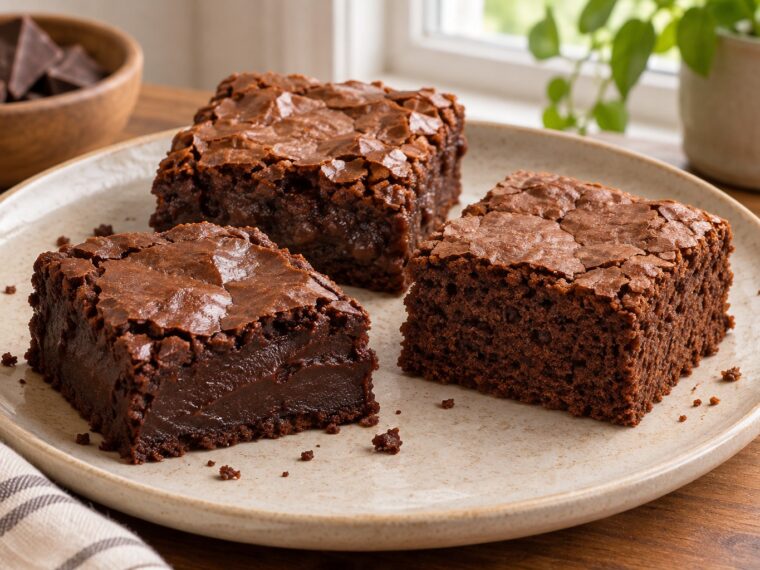
Brownie Texture Explained: Fudgy, Chewy, and Cakey
A fudgy brownie and a cakey brownie can contain many of the same ingredients. Learn how their proportions…