Why Chocolate Ganache Splits and How to Approach a Repair
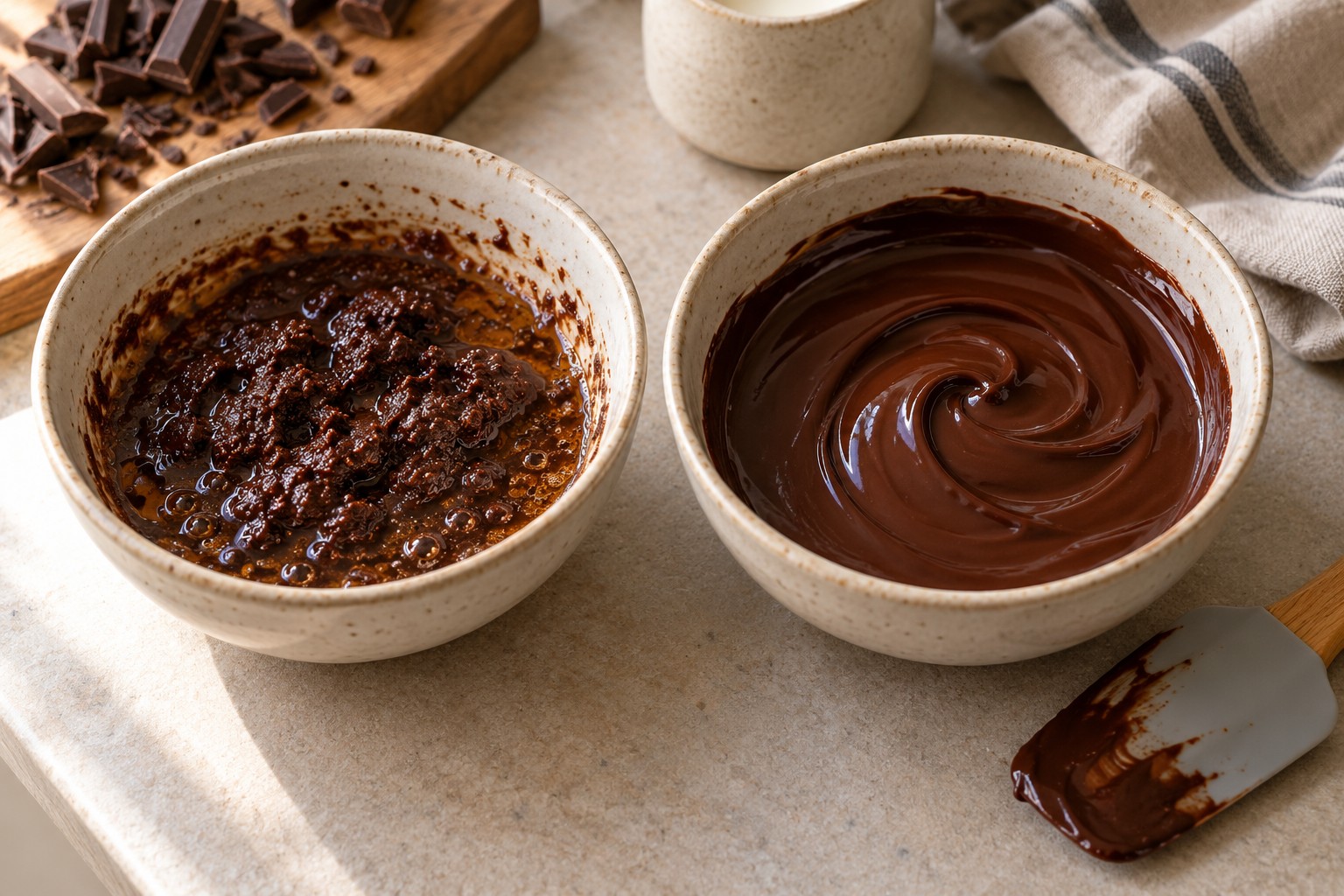
A shiny puddle of fat around rough chocolate is a reason to pause before adding anything else. More heat, more cream, and harder beating are different interventions—and choosing all three at once makes the bowl harder to understand.
Understanding why chocolate ganache splits starts with checking whether it has actually separated. Smooth ganache that is too firm needs a different response from an oily mixture, and a few unmelted chocolate pieces do not necessarily mean the whole batch has broken.
Read the texture before choosing a repair
Look across the surface, then draw a spatula through the mixture. Separate oily beads or pools alongside a grainy, uneven chocolate mass suggest a broken emulsion. A uniformly smooth mixture that holds a stiff ridge may simply be colder than its intended working condition.
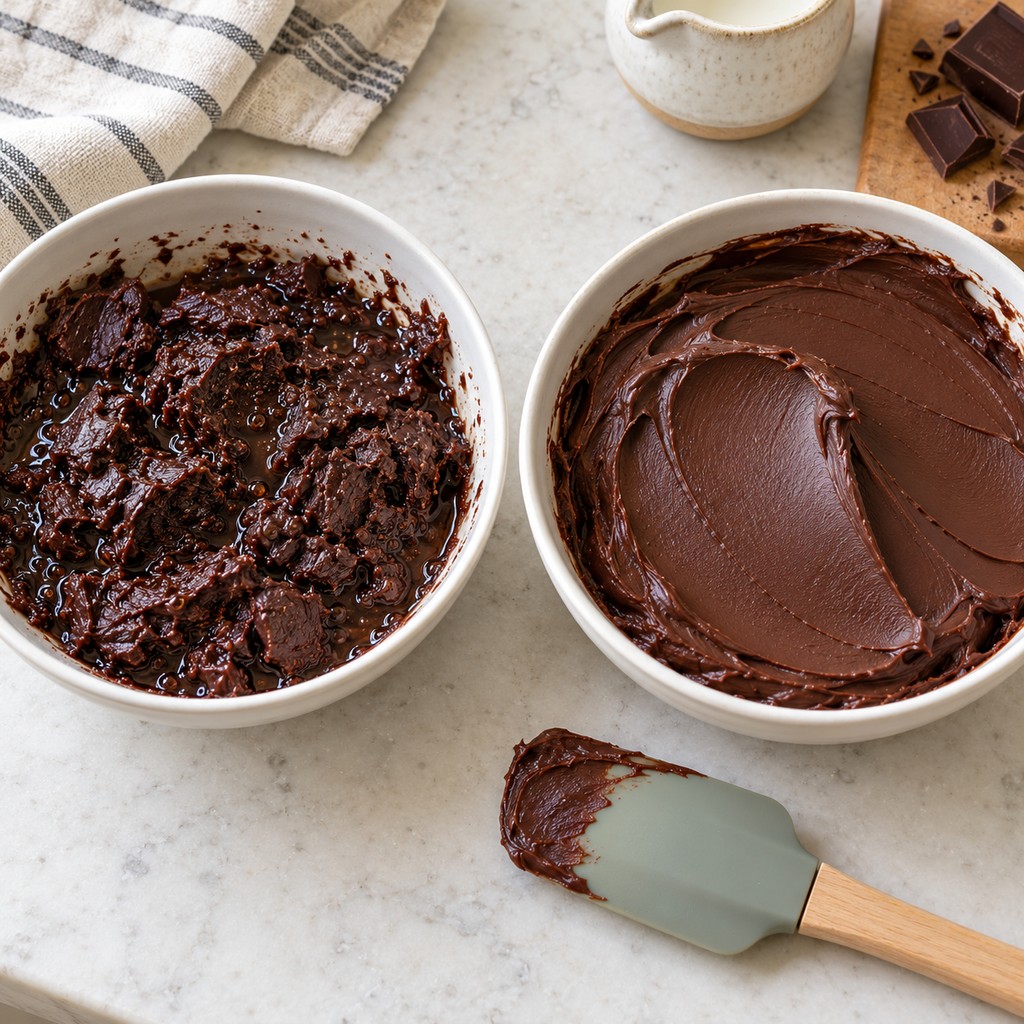
Use these observations to choose where to investigate first:
| What you see | What to check before adding ingredients |
|---|---|
| Oily pools with rough chocolate clumps | Recent overheating, ingredient proportions, and whether the mixture was fully combined |
| Distinct chocolate pieces in otherwise smooth ganache | Whether the pieces had enough time and gentle heat to melt |
| Smooth ganache that is too stiff to spread | Cooling and the recipe’s intended application consistency |
| Smooth ganache that flows more than expected | Whether it is still warm and whether the formula suits the intended use |
These are starting points rather than certain diagnoses. A glossy surface alone is normal; the more useful warning is visible fat separating from an uneven mixture underneath.
For the broader relationship between ingredients, cooling, and intended use, see Chocolate Ganache Basics: Ratios, Temperature, and Texture. Here, the focus is what to do when that mixture becomes unexpectedly uneven.
Why a ganache can lose its smoothness
Ganache brings together water-based and fat-based components. Valrhona’s explanation of chocolate emulsions describes a successful mixture as smooth and cohesive. Temperature, mixing, and the balance of ingredients all matter to that result.
Heat can become part of the problem
Think back to the last heating step. Did the ganache become oily immediately after a long microwave burst? Was it heated directly in a saucepan while you tried to melt the final pieces?
Overheating is a recognized cause of separation. Once that has happened, continuing the same heating approach gives you little control. Remove the bowl from the heat and inspect it before deciding on the next step.
A cold, stiff batch presents a different situation. If it is still smooth, restore its working consistency with the gentle reheating method in its recipe. Do not treat firmness alone as a reason to dilute it.
The formula may have changed without looking very different
Check the actual chocolate and cream packages against the recipe. A different chocolate product, an unmeasured addition of butter, or a cream substitution changes the starting point. Adding extra chocolate because freshly mixed ganache looked thin also changes the formula before cooling has answered the texture question.
Write down the ingredient weights and any additions. “Dark chocolate and whipping cream” is less useful for troubleshooting than the product names, quantities, and sequence you actually used.
In Indonesia, check whether the chocolate is labeled as chocolate or compound coating, and whether the cream is dairy cream or a non-dairy whipping product. Keep the repair guidance attached to the ingredients it was written for rather than assuming those products behave identically.
An unfinished mixture can look alarming
If you are still incorporating the recipe’s measured liquid, an uneven intermediate stage does not automatically call for extra ingredients. Valrhona notes that separation can appear early during its staged emulsification method.
Finish the specified incorporation sequence before deciding that the completed formula has failed. This is different from repeatedly stirring a finished, oily batch without changing the condition that caused the problem.
Approach a repair one change at a time
Start with the recipe’s own troubleshooting directions if it provides them. The sequence below is intended for a plain, unwhipped chocolate-and-dairy-cream ganache; it is not a universal repair for whipped ganache, compound coatings, or mixtures containing substantial additional ingredients.
First, separate melting from emulsifying
If you can identify solid chocolate pieces and the surrounding ganache is smooth, use brief, gentle reheating as directed by the recipe, stirring between applications. Stop heating when the pieces have softened enough to incorporate. King Arthur Baking’s ganache recipe specifically allows very brief reheating for remaining hard bits.
For a smooth batch that became firm after cooling, the same source recommends low-temperature reheating to restore flow. Neither situation automatically requires more liquid.
If the bowl is already hot and oily, take it off the heat. Avoid another long microwave burst as an attempt to force it smooth.
For a genuinely split batch, consider gradual warm-water additions
For oily, grainy ganache, King Arthur Baking’s broken ganache guide recommends adding warm water gradually while whisking. Water supplies liquid without adding more fat.
Use clean drinking water warmed to approximately 32–35°C. Have a teaspoon ready so you can control each addition rather than pouring from a kettle.
- With the bowl off direct heat, add a small amount of the warm water. King Arthur’s method starts with a teaspoon; use less for a very small batch.
- Whisk thoroughly and observe whether the rough mixture begins to gather into a smoother, cohesive texture.
- Add another small amount only if needed, incorporating it fully before deciding again.
- Stop adding water when the ganache becomes uniform and the separate oily pools disappear.
Do not pour in a large quantity to hurry the process. This is a gradual adjustment with an observable endpoint, not a new fixed ratio for every bowl. A tiny batch and a large batch cannot sensibly receive the same total addition.
Record how much water you added. If repeated additions are producing a thinner mixture without restoring cohesion, stop improvising rather than continuing indefinitely.
Why adding cream is a separate decision
Cream adds both liquid and fat, so it is not equivalent to water in this repair. Extra butter or oil adds another variable as well. Avoid alternating between cream, butter, chocolate, and water while trying to identify what helps.
If your specific recipe provides a cream-based rescue, follow its conditions. Otherwise, use one clearly defined approach and assess the result before changing direction. The water method above is a sourced option, not a guarantee that every formulation will recover.
Check what the repaired ganache can actually do
A smooth bowl is the first endpoint. Suitability for your cake is the next one. Added water changes the formula, so the repaired ganache may no longer set or spread exactly as originally intended.
Set aside a small spoonful and let it reach the recipe’s intended application condition while following its handling instructions. Draw a spatula through it, or spread a little on a spare piece of cake. Look for an even texture and enough body for the job.
For example, a repaired mixture might spread smoothly but remain softer than the filling you planned. That is a reason to reconsider its use before placing it between layers. Do not assume that a glossy appearance establishes filling stability.
Persistent roughness, recurring oily separation, or a visibly scorched batch are reasons to stop the repair attempt and start again for a finish that depends on smooth ganache. A texture repair also does not establish food safety or restart a storage period; continue to follow appropriate handling instructions for the ingredients and finished dessert.
Give the next batch a clearer starting point
Keep the original ingredient weights, chocolate product, cream product, and heating sequence together in your notes. Add the moment the texture changed: “smooth before reheating, oily afterward” is more useful than “ganache failed.”
For the next attempt, prepare evenly chopped chocolate, follow the recipe’s softening pause, and use controlled heat rather than trying to melt every remaining piece in one long burst. Judge the ganache at its intended working condition before changing the proportions.
The most useful first question is simple: is this mixture separated, incompletely melted, or merely at the wrong temperature for its job? Answering that before reaching for another ingredient gives the repair a clearer direction.
Bake & panduan terkait
Simple Buttercream: Butter Temperature, Sugar, and Spreadability
Soft butter is only the beginning. Learn to read your buttercream as you mix, adjust it for spreading…
Dark Chocolate Ganache for Spreading: A Recipe with Consistency Cues
A smooth ganache needs time to become spreadable. Follow this dark chocolate recipe, then watch for soft folds…
Chocolate Ganache Basics: Ratios, Temperature, and Texture
Ganache changes as it cools. Learn how chocolate choice, cream proportions, and temperature work together, with practical cues…