
Why Baked Custard Turns Grainy or Releases Liquid
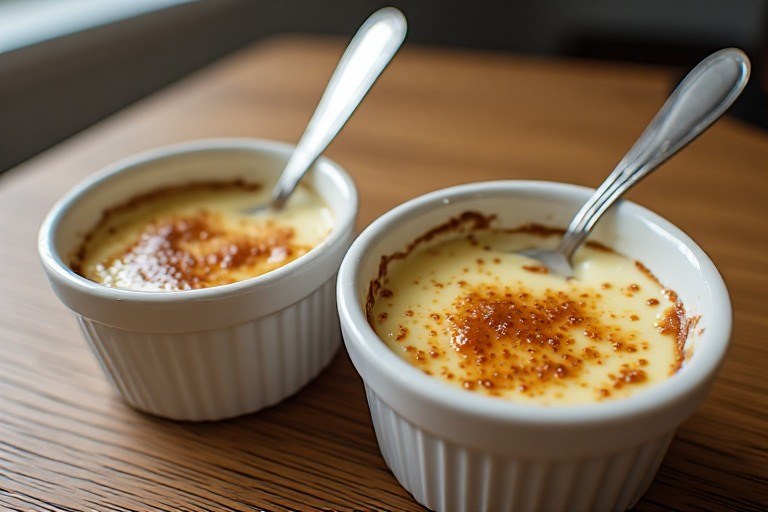
A spoon breaks into the custard, and instead of a smooth scoop, you find tiny curds with watery liquid gathering beside them. Giving the next batch more time in the oven may seem sensible when you see liquid—but if the custard has already overcooked, that moves it further from the texture you wanted.
The useful distinction is between liquid released by a grainy, set custard and a center that never finished setting. Start there, then work backward through the baking and mixing stages. This guide focuses on plain egg-and-dairy baked custard cups, rather than starch-thickened pastry cream or custard tarts designed for higher heat.
First, identify what kind of wetness you have
Before calling the custard watery, look at the surrounding texture and where the moisture sits. These observations narrow the investigation; none establishes the cause or food safety on its own.
| What you notice | What to investigate first |
|---|---|
| Fine curds or a spongy texture with liquid around the set custard | Excessive heat or prolonged baking |
| Firm edges with a center that still flows freely during baking | Uneven heating, fill depth, and incomplete setting |
| Drops on the underside of a cover above an otherwise smooth custard | Condensation rather than separation within the custard |
| One unusually watery cup after filling the bath | Whether bath water splashed into that portion |
| Small lumps already visible before baking | Mixing and the addition of hot dairy |
A little surface moisture does not automatically mean the whole custard has curdled. Conversely, a firm outer ring does not establish that the center finished cooking. Note both the location of the liquid and the texture beneath it.
For the wider method, including vessel choice and bath setup, use baked custard basics. Here, the question is what changed between a smooth mixture and the finished spoonful.
Why overheating produces graininess and liquid together
As an egg custard cooks, its proteins form the structure that holds the liquid. Excessive heating can make that structure tighten and separate, leaving small curds and released moisture. The liquid separation is called syneresis, often described as weeping. The American Egg Board’s Eggcyclopedia explains this connection between excessive cooking, protein coagulation, and separation.
That is why graininess and watery liquid can appear together. The mixture has not simply failed to absorb its milk; its structure has changed during cooking. More baking will not turn those curds back into a smooth, delicate set.
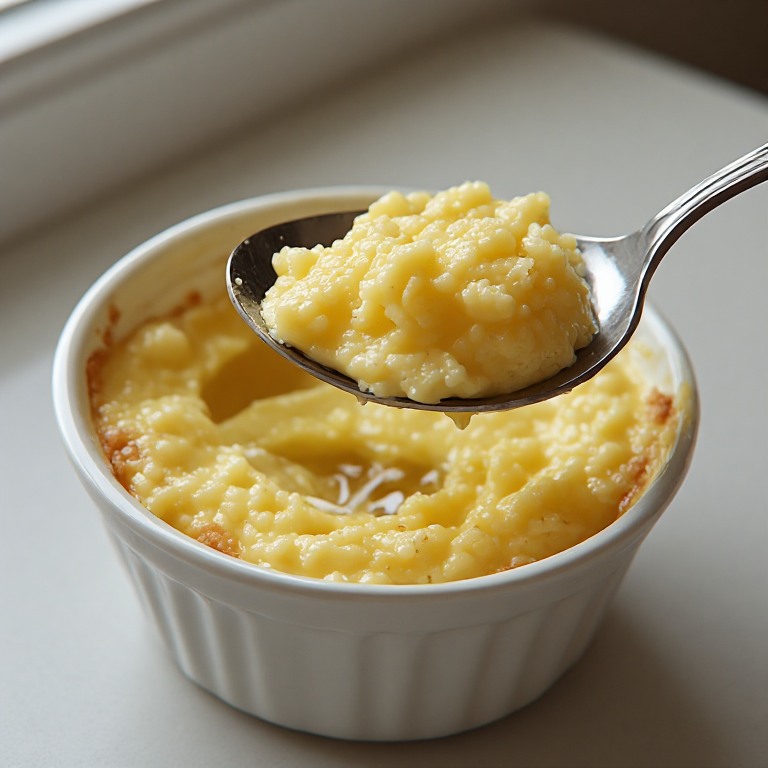
Look back at the endpoint. Did you wait until the center stopped moving completely? Did the surface puff or bubble strongly? Did the edges become noticeably firm while you kept baking for the middle? Those are useful observations to record when investigating excessive heat, especially when the chilled custard is coarse around the outside.
Do not use a browned top as the target for a plain custard cup. Follow the chosen recipe’s setting cues rather than borrowing the appearance of a browned tart or a dessert with a separately caramelized topping.
Check why the edges finished before the center
Uneven baking can leave you with two problems at once: overdone custard near the dish and a center that still needs cooking. Raising the oven temperature to hurry the middle can make that difference harder to manage.
Start with the recipe’s oven mode and temperature. If it specifies conventional heat, a fan setting introduces a different condition. Follow the recipe or appliance guidance for conversion. If the same problem repeats with otherwise consistent preparation, an oven thermometer can help you investigate the actual oven temperature.
Next, compare the dishes and fill depths. A narrow, deep portion does not bake on the same schedule as a shallow one merely because both dishes hold the same total volume. Within a batch, keep the cups similar and divide the mixture evenly. Assess a noticeably fuller cup separately rather than holding every finished portion in the oven for it.
Check the water bath too. The American Egg Board’s baked custard guidance explains that the bath helps protect the edges from overcooking before the center is ready. Use the water temperature and depth specified by your recipe, keeping the water below the rims. A bath moderates heating; it does not prevent overcooking indefinitely.
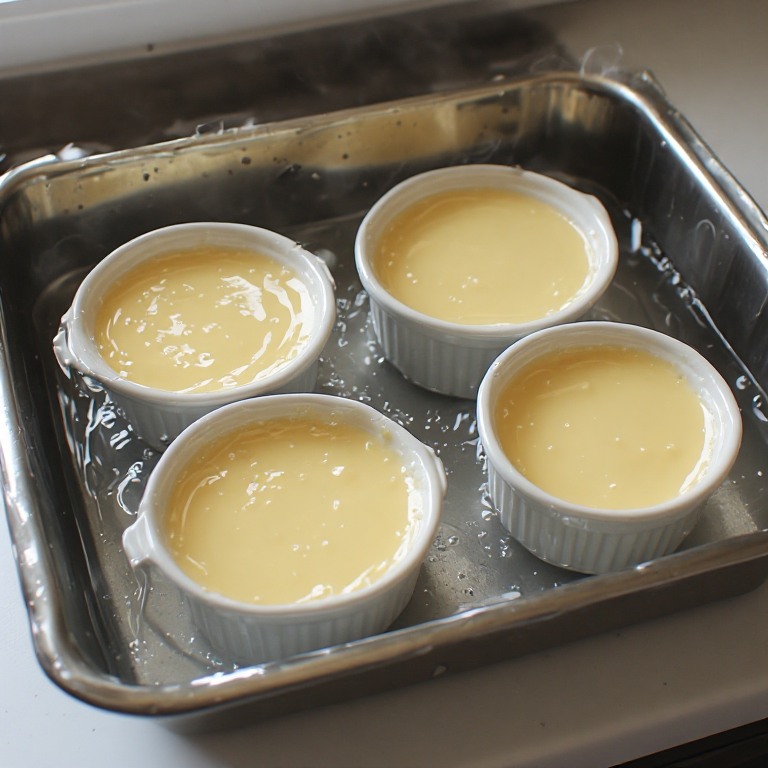
Record the setup before changing it: dish shape, fill depth, rack position, oven mode, and bath preparation. If the formula is unchanged but the dishes are much deeper, that is a clearer starting point than assuming the custard needs another egg.
Separate a gentle wobble from an unfinished center
For many individual custards, set edges and a small, connected central tremble are useful texture cues. A middle that rolls in loose, liquid waves is a different observation. Give the pan only a small, controlled nudge so that you can see the custard’s movement without splashing the bath.
Use those observations alongside the recipe’s temperature instructions. A pleasing wobble cannot verify food safety. The FDA’s egg-safety guidance recommends cooking egg dishes to 160°F, approximately 71°C, checked with a food thermometer. Position the sensing area in the center without touching the dish. That safety recommendation is not a universal ideal texture endpoint for every custard formula.
If the center is still freely liquid during baking, continue according to the recipe and assess it again. Refrigeration is not a substitute for finishing the cooking stage. If the outside is already coarse while the middle remains loose, note the uneven result rather than treating the whole cup as simply underbaked.
Once the cups meet the recipe’s endpoint and appropriate safety guidance, remove them from the bath as directed. For the individual cups discussed here, leaving them sitting in hot water adds further heating after the oven stage. Prepare a stable heatproof landing area and use suitable protection and a secure grip.
If the mixture was lumpy before it reached the oven
Think back to the pouring jug. A custard that already contained cooked egg particles before baking has a different starting problem from one that was smooth until it spent too long in the oven.
When the recipe uses hot dairy, follow its gradual addition sequence while stirring. Avoid pouring the entire saucepan onto one area of egg. Blend the eggs and sugar evenly without whipping them into a thick foam, then strain as instructed before filling the cups.
A sieve can catch egg strands and small unwanted particles. It does not restore the original mixture after substantial scrambling. If a noticeable quantity of cooked egg remains in the sieve, do not assume the strained liquid still has the recipe’s intended proportions.
Also distinguish bubbles from curds. Foam sitting on the mixture before baking points you toward aeration and skimming. Graininess throughout a spoonful with separated liquid points you toward a different investigation. Calling both problems “rough texture” hides a useful clue.
Review substitutions before changing the heat again
If the oven setup matches the recipe but the result remains unexpected, return to the ingredient list. Check the quantities and types of egg, dairy, and sugar rather than relying on how familiar the cartons look.
For home baking in Indonesia, plain full-cream milk, evaporated milk, sweetened condensed milk, and sweetened creamer should not be treated as interchangeable ingredients. A substitution changes the formula you are trying to assess. The same caution applies to replacing dairy with coconut milk or a plant drink, reducing sugar substantially, or changing whole eggs to yolks alone.
Use Vanilla Baked Custard Cups if you need a complete formula and sequence. Keep its measured ingredients and dish sizes consistent before experimenting. Adding an extra egg or a spoonful of starch to repair a disappointing result creates a new formulation rather than identifying what happened to the original one.
Can a grainy baked custard be made smooth again?
Once a baked custard has formed curds and released liquid, there is no reliable finishing step that restores its original smooth, set texture. Extra baking, longer chilling, or pouring off the liquid does not reverse the underlying change.
Advice about whisking or blending a slightly split stirred custard should not be transferred automatically to a baked custard cup. Breaking up its set structure produces a different result; it does not return the dessert to an undisturbed baked custard.
Texture also cannot tell you whether a portion is safe to eat. Keep cooking and storage history separate from the question of whether its mouthfeel is acceptable. Refrigerate promptly rather than leaving cups out until completely cold. FDA guidance sets an outside limit of two hours unrefrigerated, reduced to one hour above 32°C; these are limits, not suggested cooling times. Keep the refrigerator at 4°C or below and use properly handled cooked egg dishes within three to four days. Discard portions left out beyond those limits.
Give the next batch one useful adjustment
Choose the clearest observation from the failed batch. If the center was already set before removal but the cups remained in the bath, focus on the endpoint and removal sequence. If the edges were coarse while a deep center still sloshed, restore the recipe’s dish size and oven setup. If lumps appeared during mixing, address that stage before changing the baking temperature.
Keep a short note of the result after chilling: “smooth center, grainy outer ring, liquid at the edge” tells you more than “too wet.” Pair that with what you saw in the oven. The next batch becomes easier to understand when the adjustment answers a specific observation.
Bake & panduan terkait
When to Cut Brownies for Neater Slices
A cool brownie slab is easier to lift and portion than a warm one. Learn the cues to…
Why Brownies Turn Dry at the Edges Before the Center Sets
Dry edges and a soft middle can point to a mismatch between the batter, pan, and oven. Learn…
Fudgy Cocoa Brownies: A Recipe with Center and Edge Cues
These small-batch cocoa brownies use a loaf pan and a straightforward mixing method. Learn what set edges, a…